Top 10 Questions to Ask Before Signing a Warehouse Lease in 2026
Introduction
Signing a warehouse lease is one of the most significant financial decisions a business can make. Whether you’re a startup scaling operations, an e-commerce brand looking for fulfillment space, or an established manufacturer expanding capacity, the lease agreement you sign will directly impact your bottom line, operations, and growth for years to come.
In 2026, the warehouse rental market is more competitive than ever. With rising demand from e-commerce, last-mile delivery, and supply chain restructuring, landlords often hold the upper hand — making it absolutely critical that tenants ask the right questions before signing on the dotted line.
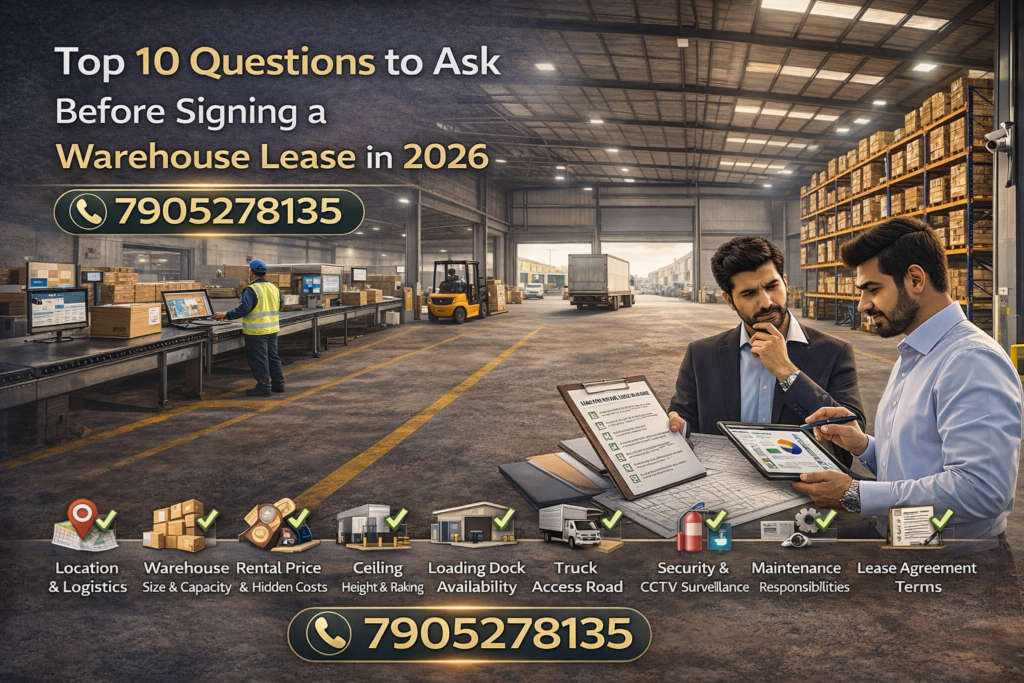
This comprehensive guide covers the Top 10 Questions you must ask before signing any warehouse lease in 2026. By the end of this article, you’ll know exactly what to look for, what red flags to watch out for, and how to negotiate terms that protect your business.
Why Asking the Right Questions Matters in 2026
The warehouse rental landscape has changed dramatically. Here’s what’s happening in 2026 that makes lease negotiations more important than ever:
- Warehouse vacancy rates remain tight in major metros — under 4% in cities like Dallas, Chicago, and LA.
- Triple-net (NNN) leases are now the standard, meaning tenants pay more than just base rent.
- Energy costs, insurance premiums, and labor costs have all risen, making hidden lease costs more impactful.
- E-commerce growth continues to drive demand for last-mile and mid-mile fulfillment centers.
- Many landlords are including aggressive escalation clauses that increase rent 3–5% annually.
Without asking the right questions, you could end up locked into a lease that drains your cash flow, restricts your operations, or forces you to pay for expensive buildouts you didn’t anticipate.
The Top 10 Questions to Ask Before Signing a Warehouse Lease
Q1. What Does the Total Monthly Cost Include?
Many tenants focus only on the base rent per square foot and are shocked when the first invoice arrives. In 2026, most commercial warehouse leases are structured as Triple Net (NNN), meaning you pay base rent PLUS a share of property taxes, building insurance, and common area maintenance (CAM) charges. Always ask for a full cost breakdown.
- Base rent (per sq ft per year or month)
- Property taxes (your proportionate share)
- Building insurance premium allocation
- CAM charges — parking lot, landscaping, security, lighting
- Utilities — electricity, water, gas (are they metered separately or shared?)
- HVAC maintenance responsibility
- Trash removal and pest control fees
Q2. What Is the Lease Term and Renewal Options?
Lease term is a double-edged sword. A short term gives you flexibility, while a longer term typically locks in lower rent but ties up your business. In 2026, landlords are pushing for 5–10 year terms, especially for large spaces. Before agreeing, consider your 3–5 year business growth forecast carefully.
- What is the initial lease term? (1 year, 3 years, 5 years, 10 years)
- Are there renewal options and at what rent increase?
- Is there a right of first refusal on adjacent units if you expand?
- What is the notice period required to exercise renewal options? (typically 6–12 months)
- Can you sublease or assign the lease if your business changes?
Q3. What Are the Permitted Uses of the Space?
Warehouse leases often contain strict permitted use clauses that define exactly what activities you’re allowed to conduct in the space. Using a warehouse for activities outside the permitted use can trigger lease termination. This is especially important if you plan to do manufacturing, store hazardous materials, or operate retail-facing pick-up points.
- Is the space zoned for your type of business (industrial, commercial, mixed-use)?
- Can you store the types of goods your business requires?
- Is there any restriction on operating hours (shifts, 24/7 access)?
- Are you allowed to store flammable, refrigerated, or hazardous materials?
- Can customers, drivers, or third-party carriers access the property?
- Are there restrictions on signage or branding on the exterior?
Q4. Who Is Responsible for Repairs and Maintenance?
Maintenance responsibilities in warehouse leases are often misunderstood and heavily negotiated. In NNN leases, tenants are typically responsible for interior maintenance — including HVAC systems — while the landlord handles structural components like the roof and foundation. However, this varies widely by lease.
- Who maintains the HVAC system — tenant or landlord?
- Who covers roof repairs, parking lot repaving, and structural repairs?
- Are there any deferred maintenance issues in the building you should know about?
- What is the process and timeline for requesting repairs from the landlord?
- Is there a maintenance cap (e.g., tenant responsible for HVAC up to $5,000/year)?
Q5. What Are the Loading Dock and Access Specifications?
For most warehouse tenants, the loading dock is the operational heartbeat of the facility. Poor dock specifications can cripple your logistics efficiency and increase labor costs significantly. This is one of the most overlooked questions — don’t skip it.
- How many dock doors does the space include? Are they sufficient for your volume?
- Are dock levelers included and what condition are they in?
- What is the clear height of the warehouse? (Modern logistics needs 28–36 ft clear height)
- Is there adequate truck court depth for semi-trucks to maneuver? (120+ ft is ideal)
- Are there drive-in grade-level doors? How many and what size?
- What is the floor load capacity (PSI rating)?
- Is there adequate parking for employees and visiting carriers?
Q6. What Are the Rent Escalation Terms?
Rent escalations are built into virtually every long-term warehouse lease and are one of the biggest sources of cost surprises for tenants. In 2026, with inflation still a concern, landlords are pushing for 3–5% annual increases. Negotiating this clause can save you tens of thousands over a 5-year lease.
- How much does rent increase each year? (Fixed % or tied to CPI?)
- Is the CPI cap negotiable? (Push for a cap of 2–3% even if tied to CPI)
- Are there any rent-free periods at the start of the lease?
- Is there a tenant improvement (TI) allowance to offset buildout costs?
- What happens to rent if market rates decline significantly?
Q7. What Are the Early Termination and Exit Clauses?
Business needs change. The e-commerce company that signed a 7-year warehouse lease in 2021 may have very different space needs in 2026. Before signing, understand what it will cost you to exit early — because you may need to.
- Is there an early termination option (kick-out clause) and under what conditions?
- What is the penalty for breaking the lease early? (Typically 3–6 months rent)
- Are you allowed to sublease the space if your business downsizes?
- What constitutes a default from the landlord’s side, and what are your remedies?
- What happens at the end of the lease — do you need to restore the space to original condition?
- What is the notice period for vacating at the end of the term?
Q8. What Are the Insurance Requirements?
Every commercial warehouse lease includes tenant insurance requirements. Failing to maintain adequate coverage is a lease default. In 2026, standard requirements have increased significantly due to rising property values and liability risks. Understand what’s required before you get your insurance quotes.
- What is the minimum general liability insurance requirement? ($1M, $2M, or more per occurrence?)
- Is commercial property insurance required for your equipment and inventory?
- Is the landlord named as an additional insured on your policy?
- Are you required to carry workers’ compensation, auto liability, or umbrella coverage?
- Who is responsible for insuring the building structure vs. tenant improvements?
Q9. What Utilities and Infrastructure Are Available?
Modern warehousing operations are increasingly power-hungry — from EV charging stations for delivery fleets to high-wattage cold storage systems. Before signing, ensure the building’s infrastructure meets your current and future operational needs.
- What is the electrical power capacity? (Amps, voltage — 3-phase power available?)
- Is there sufficient power for your lighting, equipment, and any cold storage needs?
- Is there natural gas available for heating or industrial use?
- What is the internet/fiber connectivity situation? Are multiple providers available?
- Are utilities metered individually or shared/allocated among tenants?
- Is the building solar-ready or does it have renewable energy infrastructure?
- Is there EV charging infrastructure or the ability to install it?
Q10. What Security and Safety Measures Are in Place?
Warehouses store valuable inventory and equipment and employ workers — making security and safety compliance non-negotiable. Before signing, assess the facility’s existing security infrastructure and understand what you’re expected to provide as a tenant.
- Is there perimeter fencing and controlled gate access?
- What surveillance (CCTV) systems are in place and who monitors them?
- What is the history of break-ins or theft incidents at this property?
- Is the building compliant with fire safety codes? (Sprinkler systems, fire exits, etc.)
- Are there any pending safety or code violations on the property?
- Is there on-site security staff or a security service patrol?
- What lighting exists in the truck court, parking lot, and loading areas?
FAQ'S
Warehouse lease terms in 2026 typically range from 1 to 10 years. Smaller spaces (under 5,000 sq ft) may have shorter 1–3 year terms, while larger industrial facilities (25,000+ sq ft) often require minimum 5-year commitments. Landlords in high-demand markets often prefer 5–7 year terms. As a tenant, try to balance the stability of a longer term with flexibility through built-in renewal options and, if possible, an early termination clause.
A Triple Net (NNN) lease is the most common commercial warehouse lease structure. It means the tenant pays: (1) Base Rent, (2) Property taxes (proportionate share), and (3) Building insurance and CAM charges. Unlike a gross lease where one flat rate covers everything, an NNN lease separates these costs. This means your actual monthly payment is base rent PLUS NNN charges, which can add 20–40% to the base rent figure. Always ask for the estimated NNN charges before comparing lease options.
Clear height is the usable vertical space from the floor to the lowest overhead obstruction (beams, sprinklers, or lights). This is critical for businesses using racking systems or forklifts. Standard warehouses built before 2000 often have 18–24 ft clear heights. Modern distribution centers typically offer 28–36 ft clear heights, which allow for significantly more vertical storage. If you plan to use pallet racking, you’ll want at least 24–28 ft clear height to maximize storage capacity.
Yes, almost always. While landlords set asking rates, rent is negotiable — especially if the market has available inventory, you’re signing a long-term lease, or you’re bringing creditworthy financials. Besides base rent, you can negotiate free rent periods, tenant improvement allowances, CAM caps, parking ratios, signage rights, renewal option rates, and early termination rights. Hiring a tenant rep broker is the most effective way to ensure you’re negotiating from a position of market knowledge.
A personal guarantee is a clause where an individual (typically the business owner) personally agrees to be responsible for the lease obligations if the business defaults. For startups or businesses with limited credit history, landlords often require this. If asked to sign a personal guarantee, try to negotiate: (a) a time-limited guarantee (e.g., only for the first 2 years), (b) a cap on the guaranteed amount, or (c) a burn-down clause where the guarantee reduces as you demonstrate on-time payment history.
A common rule of thumb is to multiply your annual inventory volume by 1.5–2x to account for peak season surges, staging areas, receiving docks, and office space. For a simple estimate: if you store 500 pallets, you need approximately 5,000–8,000 sq ft depending on your rack height. Always add a 20–25% buffer for growth. An experienced tenant rep broker or logistics consultant can help you model your true space requirements based on your SKU count, order volume, and fulfillment workflow.
Your lease typically transfers to the new owner — a principle called ‘lease runs with the land.’ The new owner must honor the existing lease terms, including your rent, renewal options, and TI allowances. However, it’s important to have an Attorney and Non-Disturbance Agreement (SNDA) in your lease, which formally protects your tenancy rights if the building is sold or if the landlord’s lender forecloses. Ask your attorney to include this clause before signing.
Both have advantages. Industrial parks offer shared infrastructure (security, loading areas, truck courts), professional management, and often more flexibility with shorter lease terms and smaller unit sizes. Standalone buildings typically offer more customization, exclusive truck access, larger footprints, and sometimes lower per-square-foot rates. For businesses needing heavy branding, exclusive dock access, or large outdoor storage, standalone buildings are often preferred. For businesses looking for plug-and-play space with professional management and community, industrial parks are an excellent choice.
Conclusion
Signing a warehouse lease is not something to rush. The questions covered in this guide — from total cost breakdowns and permitted uses to rent escalations and exit clauses — are the essential due diligence every business must complete before committing to an industrial space.
In 2026’s competitive warehouse rental market, knowledge is your greatest negotiating asset. Landlords are experienced — but so are well-prepared tenants who ask the right questions, understand the lease structure, and work with qualified tenant rep brokers and attorneys.
Before you sign any warehouse lease, use this guide as your starting point. Ask every question, document every answer, and never be afraid to walk away from a deal that doesn’t align with your business needs and financial goals.