What Is a Dark Store and How Location Decides Its Success in India
You Order Groceries on Blinkit at 11 PM and They Arrive in 12 Minutes. The Place That Makes This Possible Is Called a Dark Store.
Most Indian consumers have used Blinkit, Zepto, Instamart, or BigBasket Now and wondered: how does a bag of groceries reach my door in 10 to 15 minutes? The answer is a dark store — a type of storage facility that looks nothing like a traditional warehouse and works completely differently from a retail store.
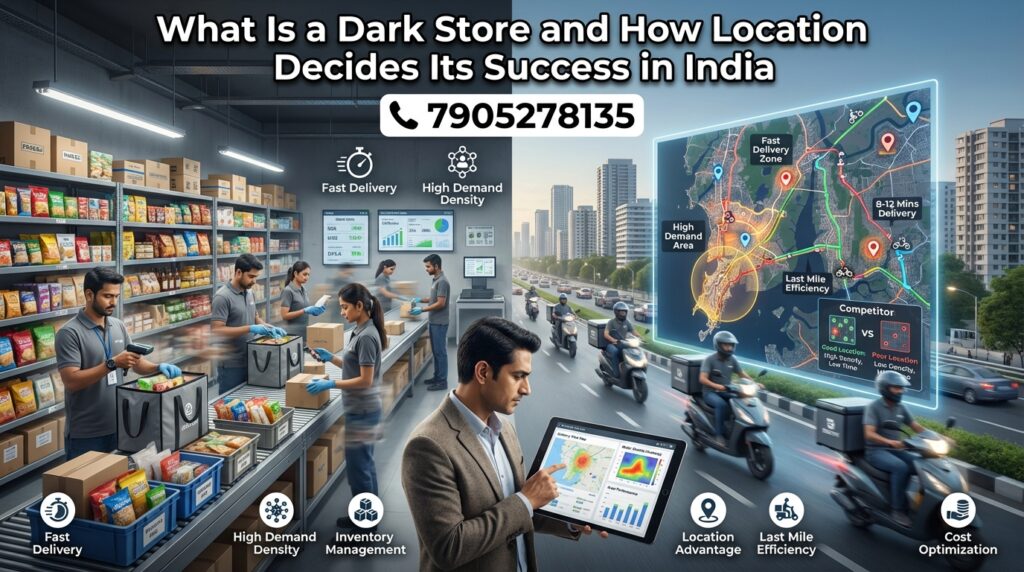
A dark store is not a store you visit. It is a store that exists only to serve online orders. No customers walk in. No display racks or checkout counters. Just organised stock, trained pickers, and delivery riders — all optimised for one thing: getting your order out the door in under 5 minutes. Understanding how dark stores work and why location is their make-or-break factor is essential knowledge for any Indian business considering this model in 2026.
What Exactly Is a Dark Store?
A dark store is a fulfillment-only retail or storage facility — a small to mid-sized space, typically 1,000 to 5,000 sq ft, located inside a city’s residential neighbourhoods or commercial areas, stocked with high-demand SKUs, and staffed with pickers who fulfill online orders exclusively. No public entry. No signage welcoming shoppers. Hence ‘dark’ — closed to the public.
The operational principle: when a customer places an order through a quick commerce app, the system identifies the nearest dark store with the item in stock, a picker pulls the item within 60 to 90 seconds, it is packed and handed to a waiting delivery rider, and the rider is at the customer’s door within 10 to 20 minutes of the order being placed.
Feature | Dark Store | Traditional Warehouse | Retail Store |
Customer access | No — fulfilment only | No — storage only | Yes — public welcome |
Location | Inside city, near customers | Outside city, near highways | High street / mall |
Size | 1,000–5,000 sq ft (micro to mid) | 10,000–1,00,000+ sq ft | 500–50,000 sq ft |
Primary function | Ultra-fast order fulfilment (10–30 min) | Storage and bulk distribution | Sales and customer service |
SKU count | 300–3,000 (curated fast-movers) | 5,000–1,00,000+ | 1,000–50,000 |
Delivery radius | 1–5 km (hyper-local) | City-wide to national | Walk-in customers only |
Rent per sq ft (India) | ₹25–₹80/sq ft (premium city location) | ₹10–₹25/sq ft (logistics corridor) | ₹100–₹500+ (retail premium) |
Key success driver | Location within customer density | Logistics corridor and freight access | Footfall and visibility |
How Location Makes or Breaks a Dark Store in India
A dark store in the wrong location is simply not competitive. The entire model is built on speed — and speed is a direct function of how close the dark store is to the customers it serves. If the average delivery distance from a dark store is 4 km instead of 2 km, the delivery time doubles. If the dark store is in an area with poor road connectivity or high traffic congestion, the delivery time becomes unpredictable.
Every minute added to delivery time reduces the dark store’s competitive advantage. This is why successful dark store operators in India — Blinkit, Zepto, Swiggy Instamart — use highly analytical location selection processes. They look at population density, average order basket data, competitor dark store coverage gaps, traffic patterns, and rider availability before committing to any location.
The 6 Location Rules for a Successful Dark Store in India
Rule 1: Population Density Above Everything
A dark store needs to be within 1 to 3 km of a high-density residential population. In Indian cities, this means targeting areas with apartment complexes, housing societies, and urban residential blocks — not low-density bungalow zones or industrial areas. The higher the household density per sq km around a dark store, the more orders it can potentially receive per hour — and the more efficiently each delivery rider’s trip can be used.
Rule 2: The 3-km Delivery Radius Rule
Most successful dark stores in India operate within a 3 km service radius. Beyond 3 km, delivery time starts approaching 20 to 25 minutes — which erodes the key differentiation of quick commerce versus standard same-day delivery. The ideal dark store location is one where 10,000 to 50,000+ households fall within a 2 to 3 km radius.
Rule 3: Road Connectivity for Delivery Riders
Even within a dense residential area, delivery riders need clear, accessible routes between the dark store and customer addresses. Areas with poor internal road quality, gated communities that delay entry, or congested markets create unpredictable delivery times. Good dark store locations have multiple route options to reach nearby residential clusters.
Rule 4: Ground Floor Accessibility for Riders
Dark stores work best at ground floor level — riders enter, collect packed orders, and exit without elevator waits or staircase delays. A dark store on the 3rd floor of a commercial building adds 2 to 4 minutes per delivery trip — which destroys the economics of a 10-minute delivery model.
Rule 5: Commercial Zoning and Lease Flexibility
Dark stores need to operate in commercially zoned property — running a high-frequency delivery operation from a residential building creates legal exposure and typically violates the use terms of a residential lease. Commercial property in residential-adjacent areas (ground floor of mixed-use buildings, commercial complexes at the edge of residential colonies) is the sweet spot.
Rule 6: The Hub-and-Spoke Link — A Larger Storage Facility Behind the Dark Store
This is the factor most observers miss when studying dark stores. A dark store itself holds only 300 to 3,000 fast-moving SKUs — the items that 80% of customers order regularly. Behind every successful dark store network is a larger storage facility or warehouse that replenishes the dark stores daily or multiple times per day. This fulfilment hub handles the bulk of inventory, manages slower-moving and larger SKUs, and dispatches replenishment stock to the dark stores on a constant cycle.
The Dark Store + Warehouse Hub Model in India
The most efficient quick commerce operations in India use a two-tier model:
- Tier 1 — Dark Store: 1,000 to 4,000 sq ft, inside city, near customers, holds 300 to 2,000 fast-moving SKUs, serves a 2 to 3 km delivery radius
- Tier 2 — Hub Warehouse: 10,000 to 50,000+ sq ft, on a logistics corridor, holds full SKU range, replenishes dark stores 2 to 4 times per day
The hub warehouse’s location is as strategic as the dark store’s location — but for the opposite reasons. While the dark store must be inside the city near customers, the hub warehouse benefits from highway access for inward supply from distributors and manufacturers, lower rent on a logistics corridor (versus premium city-centre rent), and infrastructure for heavy vehicle receiving and bulk storage.
🏭 ASHOKA WAREHOUSING — LUCKNOW Affordable Warehouse / Dark Store Space for Rent on NH-24 Sitapur Road, Lucknow 💰 Rent: Only ₹18 per sq ft — minimum rent, maximum logistics value in Lucknow 📍 Location: Sitapur Road, NH-24 — Lucknow’s top logistics corridor: warehouse near highway Lucknow 🏢 Space Type: Modern A-grade godown / commercial warehouse Lucknow — suits dark store, logistics space, storage facility, industrial shed operations 🚉 Connectivity: 20 min from Lucknow Junction | Daily courier pickup from all major platforms on NH-24 route 👥 Ideal For: Dark store operators · Q-commerce players · E-Commerce Fulfilment · FMCG distribution · Industrial shed for lease Lucknow · Bulk storage space Lucknow · Rent industrial property Lucknow |
For businesses building a dark store network in Lucknow or establishing the hub warehouse that backs a quick commerce operation, Ashoka Warehousing on Sitapur Road, NH-24 delivers exactly what a hub warehouse needs: highway location for efficient supplier deliveries and replenishment logistics, competitive rent at just ₹18 per sq ft — one of Lucknow’s most affordable rates for industrial space or commercial warehouse on a national highway, 20-minute proximity to Lucknow Junction for bulk inward rail freight, and daily courier pickup from all major logistics providers. Whether you describe your need as logistics space, a storage facility, a commercial warehouse, a godown for rent, or affordable industrial space in Lucknow — this facility serves the hub role in a dark store network or the primary fulfilment role in a single-tier quick commerce operation.
Frequently Asked Questions
Q: What is a dark store in simple terms for India?
A dark store is a small fulfilment centre — typically 1,000 to 5,000 sq ft — located inside a city’s residential areas that processes only online orders and is closed to walk-in customers. Think of it as a mini warehouse disguised as a retail storage space, staffed with pickers who can locate, pack, and hand over an order to a delivery rider in 60 to 90 seconds. In India, dark stores are the engine behind quick commerce platforms like Blinkit, Zepto, and Swiggy Instamart. They are deliberately located within 1 to 3 km of dense residential populations so that a delivery rider can reach any customer in the service area within 10 to 20 minutes. The word ‘dark’ simply means the store is dark to customers — no footfall, no visibility from the street, no shopping experience.
Q: How does a dark store make money in India?
A dark store generates revenue through the orders it fulfils — each order contributes the item margin plus a delivery or convenience fee. The economics depend on: order frequency (a dark store needs 300 to 1,000+ orders per day to cover its fixed costs of rent, staff, and inventory), average order value (higher basket sizes improve per-order profitability), inventory turns (fast-moving SKUs reduce wastage and capital lock-up), and delivery cost per order (which is a function of location — closer to customers means lower per-delivery cost). Dark store operations in India were loss-making during the aggressive expansion phase of 2021 to 2023 as companies subsidised delivery and discounted orders to acquire users. By 2025 to 2026, the leading platforms have moved toward profitability by rationalising dark store locations, increasing average order values, and reducing delivery subsidies. For an independent business operator running dark stores, the model becomes economically viable at sustained order volumes above 400 to 500 orders per day per store.
Q: Which cities in India are best suited for dark stores?
Dark stores work best in high-density urban environments with a large population of smartphone users who regularly shop online. In India, the tier classification for dark store viability is: Tier 1 cities (Mumbai, Delhi NCR, Bengaluru, Hyderabad, Chennai, Kolkata) — highest viability due to population density, high digital adoption, and existing quick commerce demand. Tier 2 cities with high urban density (Pune, Ahmedabad, Lucknow, Jaipur, Chandigarh, Coimbatore) — growing viability as smartphone penetration increases and quick commerce demand expands. Tier 3 cities — emerging opportunity in the next 3 to 5 years as the Tier 2 market matures. For Lucknow specifically, the combination of growing e-commerce adoption, a large middle-class urban population, and existing quick commerce platform expansion into the city makes it an increasingly viable market for dark store operators in 2026.
Q: Is a dark store the same as a micro-fulfilment centre?
Dark store and micro-fulfilment centre (MFC) are related concepts with some differences in usage. A dark store in India typically refers to a ground-level urban storage facility specifically designed for quick commerce and 10 to 30 minute delivery. A micro-fulfilment centre is a broader term used in global logistics that refers to any small-scale, technology-driven fulfilment facility, often embedded within or adjacent to retail stores, that uses automation to speed up order processing. In India’s current market context, most practitioners use ‘dark store’ to refer to the quick commerce fulfillment nodes and ‘mini warehouse’ or ‘satellite warehouse’ for the slightly larger urban fulfillment facilities that serve standard 2 to 4-hour delivery or next-day delivery. The practical distinction for Indian business operators: if you are building for 10 to 30 minute delivery, the dark store model applies. If you are building for 2 to 24-hour delivery, a more standard small warehouse configuration is more cost-effective.