

Cold Storage vs Dry Warehouse Which Does Your Business Need?
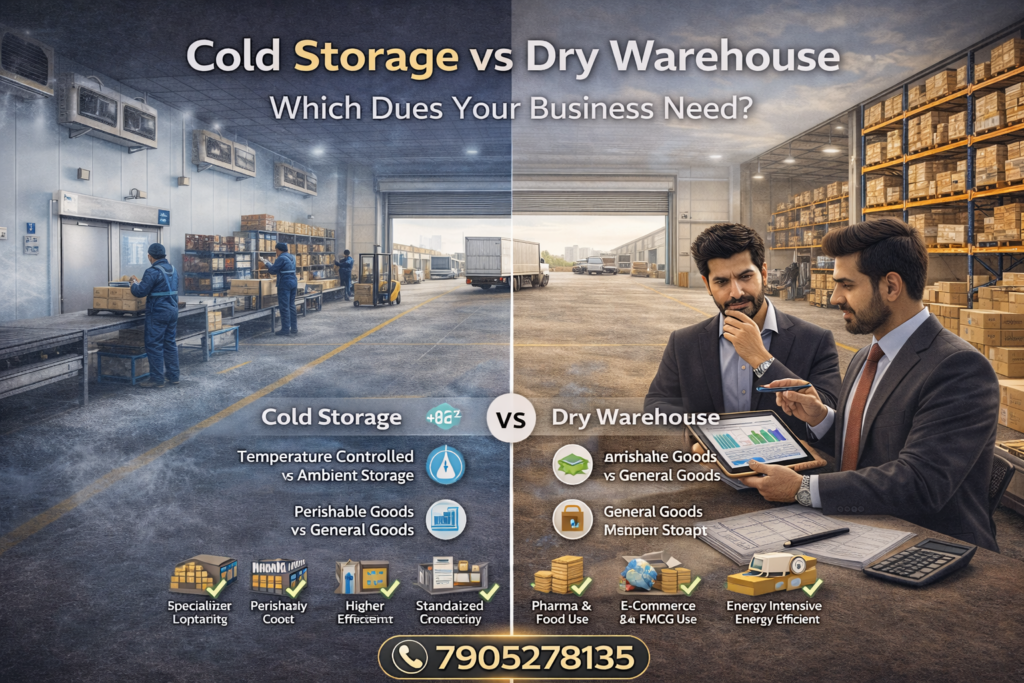
The Right Warehouse Can Make or Break Your Supply Chain
Ask most Indian business owners what type of warehouse they need and you’ll get a vague answer: ‘Just somewhere to keep my stock.’ But warehousing is not a commodity decision — the type of storage facility you choose directly affects product quality, spoilage losses, compliance status, insurance costs, and ultimately your profit margins.
In 2026, India’s warehousing sector is undergoing a transformation. The combination of GST-driven hub-and-spoke consolidation, PM Gati Shakti infrastructure push, and exploding e-commerce demand has created a sophisticated, segmented market where choosing cold storage over a dry warehouse — or vice versa — is a strategic business decision, not an afterthought.
This guide gives you the complete picture. By the end, you’ll know exactly which type of storage is right for your business, what it costs in India today, and where to find it.
Cold Storage vs Dry Warehouse: The Fundamental Difference
Factor | ❄️ Cold Storage | 🏭 Dry Warehouse |
Temperature Range | −25°C to +15°C (varies by type) | Ambient (15°C to 45°C typical in India) |
Primary Use | Perishables, pharma, dairy, frozen foods | Non-perishables, textiles, machinery, FMCG, electronics |
Infrastructure | Refrigeration systems, insulated panels, DG backup | Standard structure, basic utilities, dock levellers |
Rent Range (India 2026) | ₹35–₹120/sq ft/month | ₹8–₹28/sq ft/month |
Energy Cost | Very High (refrigeration runs 24/7) | Low to Moderate |
Compliance Required | FSSAI, WHO-GDP (pharma), APEDA (export) | Basic fire NOC, local trade licence |
Staff Requirement | Specialised cold chain trained operators | Standard warehouse staff |
Loss Risk if Power Fails | Catastrophic (hours can destroy inventory) | Minimal for most goods |
Typical Lease Commitment | 3–7 years (high capex for operators) | 1–5 years (flexible options available) |
Types of Cold Storage in India — They Are Not All the Same
One of the most common mistakes Indian businesses make is treating cold storage as a single category. There are actually five distinct types, each serving different products and operating at different costs:
1. Frozen Storage (−18°C to −25°C)
Used for frozen meats, seafood, ice cream, frozen vegetables, and deep-frozen ready meals. These are the most energy-intensive and expensive cold stores to operate. India has a significant frozen storage deficit — most existing capacity is in coastal cities (Mumbai, Kochi, Chennai) near seafood processing clusters.
2.Chilled/Refrigerated Storage (+2°C to +8°C)
Used for dairy products (milk, paneer, curd, butter), fresh fruits, vegetables, cut flowers, and pharmaceutical products requiring cold chain (vaccines, insulin, blood products). This is the fastest-growing segment in India, driven by organised dairy and pharma cold chain expansion.
3. Controlled Atmosphere (CA) Storage
Specialised for apples, pears, grapes, and other fruits where oxygen levels are precisely controlled to extend shelf life up to 8–12 months. Predominantly found in Himachal Pradesh, Uttarakhand, and Nashik. Capital-intensive — typically government-supported through NHM (National Horticulture Mission).
4. Blast Freezing Facilities
Rapid temperature reduction for freshly harvested produce or processed foods. Often integrated into processing plants. Required by export-grade seafood, meat, and ready-to-eat food processors to meet quality standards.
5.Multi-Temperature/Composite Cold Stores
Modern Grade A facilities offering multiple temperature zones under one roof. Ideal for FMCG companies and organised retail chains that need to store ambient, chilled, and frozen products from a single location. Growing rapidly in metro and Tier-1 cities.
When Your Business Needs Cold Storage — The Decision Checklist
- You manufacture, process, or distribute: dairy products, meat, seafood, poultry, fresh produce, processed foods, pharmaceuticals, vaccines, blood products, flowers, or any temperature-sensitive goods
- Your product has a shelf life under 30 days at ambient temperature — heat accelerates spoilage and microbial growth that refrigeration controls
- Your business requires FSSAI or APEDA certification for export — both regulatory bodies require temperature-controlled storage documentation
- You are experiencing significant product losses during summer months (April–June) when Indian ambient temperatures exceed 40–45°C
- Your buyers or retail chains require cold chain documentation as a procurement condition — organised retail like D-Mart, Big Bazaar, and Spencer’s increasingly mandate this
When a Dry Warehouse Is Exactly Right for You
- You deal in non-perishable goods: textiles, garments, FMCG dry goods, electronics, auto components, construction materials, paper, packaging materials, furniture, or machinery
- Your products are stable at Indian ambient temperatures and do not require humidity or temperature control
- You need flexible lease terms and lower upfront commitment — dry warehouses offer far more rental options than cold storage
- You are a trader, wholesaler, importer, exporter, or transport company needing space for staging, sorting, consolidation, and dispatch
- Your monthly warehousing budget is under ₹3–₹5 lakh and the economics of cold storage infrastructure don’t justify your product margins
The Real Cost Comparison for Indian Businesses
Cost Element | Cold Storage (5,000 sq ft) | Dry Warehouse (5,000 sq ft, ₹18/sq ft) |
Monthly Base Rent | ₹1,75,000–₹6,00,000 | ₹90,000 (at ₹18/sq ft) |
Electricity (Monthly) | ₹80,000–₹2,50,000 | ₹15,000–₹40,000 |
Maintenance (Monthly) | ₹30,000–₹80,000 | ₹5,000–₹15,000 |
Security Deposit (3 months) | ₹5.25L–₹18L | ₹2.7L (at ₹18/sq ft) |
GST on Rent (18%) | ₹31,500–₹1,08,000/month | ₹16,200/month |
Compliance Costs (Annual) | ₹50,000–₹2,00,000 | ₹10,000–₹30,000 |
Total Effective Monthly Cost | ₹3.16L–₹10.38L | ₹1.26L–₹1.65L |
Ashoka Warehousing — Premium Dry Warehouse on NH-24, Lucknow
🏭 ASHOKA WAREHOUSING — LUCKNOW Premium Dry Warehouse / Godown Available for Rent 📍 Location: Sitapur Road, NH-24 National Highway — just 20 minutes from Lucknow Junction 💰 Rent: ₹18 per sq. ft. — Highly Competitive Market Rate ✅ Ideal For: Manufacturers · Importers · Exporters · Wholesalers · Transport Companies · Logistics & Distribution Businesses 🛣️ Highway Access: Direct NH-24 frontage — seamless connectivity to Delhi NCR, Kanpur, Gorakhpur, and all major UP trade corridors |
For businesses in Lucknow and the broader UP market that need reliable, well-located dry storage at a competitive price, Ashoka Warehousing on Sitapur Road, NH-24 represents one of the best-value options currently available. At ₹18 per sq ft, this facility sits well within the market range for quality dry warehouse space in the Lucknow corridor — and the NH-24 location provides unmatched connectivity to both Delhi NCR and eastern UP trade routes.
This is not cold storage — it is a premium dry godown designed for businesses that deal in non-perishables. If your inventory includes textiles, FMCG goods, consumer electronics, auto parts, packaging materials, or general merchandise, this facility gives you the space, highway access, and competitive economics to run an efficient storage and distribution operation.
Frequently Asked Questions
Q: Can a dry warehouse be converted to cold storage in India?
Technically yes, but the economics are rarely favourable. Converting a standard dry warehouse to cold storage requires: full insulated panel lining of walls, ceiling, and floor (₹800–₹1,500/sq ft), installation of refrigeration units and compressors, dedicated heavy-duty electrical connection (3-phase, 100–500 KVA depending on size), DG backup, and structural modifications. Total conversion cost for a 5,000 sq ft facility typically runs ₹1.5–₹3.5 crore — often more expensive than purpose-built cold storage. Most businesses requiring a cold chain find it more economical to lease purpose-built cold stores rather than converting dry space.
Q: What FSSAI licence is required for cold storage in India?
Cold storage operators in India require an FSSAI Central Licence (for facilities handling food products above ₹20 crore annual turnover or operating across multiple states) or an FSSAI State Licence (for smaller operations within a single state). The licence category depends on the products stored — dairy, meat, and seafood have specific additional requirements. Additionally, cold stores used for pharmaceutical products require a drug licence from the State Drug Control Authority. Export-grade cold storage serving APEDA-registered exporters must also meet APEDA quality certification requirements.
Q: What is the current cold storage capacity deficit in India and which states have the most shortage?
India has an estimated cold storage capacity of approximately 37–40 million metric tonnes (MT) against a requirement of 60–70 MT for current agricultural produce alone — a deficit of 30–35 million MT. The most severe shortages are in eastern UP, Bihar, West Bengal (for vegetables), Andhra Pradesh/Telangana (for fruits), and Maharashtra’s Vidarbha region (for oranges and citrus). Meanwhile, states like Punjab and Himachal Pradesh have relatively better cold chain infrastructure for potatoes and apples respectively. This deficit is a significant business opportunity for cold storage investors — the government offers a capital subsidy of 35% under the Pradhan Mantri Kisan Sampada Yojana (PMKSY) for cold chain infrastructure development.
Q: Is dry warehouse rental in Lucknow competitive compared to other UP cities?
Lucknow offers very competitive dry warehouse rental rates compared to Delhi NCR and western UP industrial clusters. In 2026, dry warehouse rates in Lucknow range from ₹8–₹20/sq ft/month depending on location, quality, and amenities — with NH-24 corridor properties like Ashoka Warehousing at ₹18/sq ft representing premium, well-connected options. Compared to Noida (₹18–₹28/sq ft), Ghaziabad (₹16–₹24/sq ft), and Kanpur (₹10–₹16/sq ft), Lucknow’s NH-24 corridor delivers superior value — particularly for businesses serving the eastern UP, Nepal border trade, and Gorakhpur distribution corridors.
Q: What are the GST implications of using a cold storage vs dry warehouse for goods storage?
GST on warehouse rental services is 18% for both cold storage and dry warehouse — payable by the tenant and claimable as Input Tax Credit (ITC) for GST-registered businesses. However, there is an important exception: cold storage services for agricultural produce (vegetables, fruits, pulses, cereals) are exempt from GST when provided by a cold store to a farmer or FPO — this exemption does not apply to processed food products. Additionally, goods stored in WDRA-registered warehouses can be used as collateral for institutional credit under the Negotiable Warehouse Receipts (NWR) system, which is an additional financial benefit not available for non-registered facilities.